Living With An Ileostomy, Part 2

Going back to my own story, the first six weeks with my colostomy were a nightmare. I ended up in rehab thanks to complications from surgery. While in rehab, I ended up back in the hospital with a pleural effusion. Two weeks after leaving the hospital, I landed back in the hospital to have a liver abscess drained. Through that entire time, it didn’t matter who changed my ostomy bag, I had leaks and bag explosions often. My mom was the one who learned to change the bag, and whether it was her who changed the bag or one of the nurses, I had leaks constantly. That was until my hospital stay to drain my liver abscess. The hospital’s ostomy nurse suggested a different bag to try, along with an ostomy bag. After that, leaks were a thing of the past and I was getting several days out of each bag change. After that, life got a lot better. I got through chemo with a colostomy bag. Eventually, I learned to change the bag with help, and then finally on my own.

Then I had a check in with my surgeon and suddenly I had a decision to make. By that point, my diagnosis of Lynch Syndrome had been confirmed. I knew I was at high risk of a second, unrelated colon cancer within the next ten years. I would need a colonoscopy every year for the rest of my life. During the discussion with my surgeon, I learned I was not a candidate for a “j-pouch.” A j-pouch is an internal pouch made surgically that connects the end of the small intestine to the rectum so that an ostomy bag isn’t needed. I wasn’t an candidate because of the size and placement of my original tumor. If I opted to remove my colon, I would have a permanent ileostomy. He also warned me that likely wouldn’t be happy with a straight reconnection of my colon. My tumor had been quite large (softball size) and close enough to my rectum that I would likely spend far more time in the bathroom than I wanted. I had several months to make my decision. With several months to think and pray about it, I ultimately concluded that it was in my best interest to remove the rest of my colon (along with other body parts, but that’s a topic for another post).

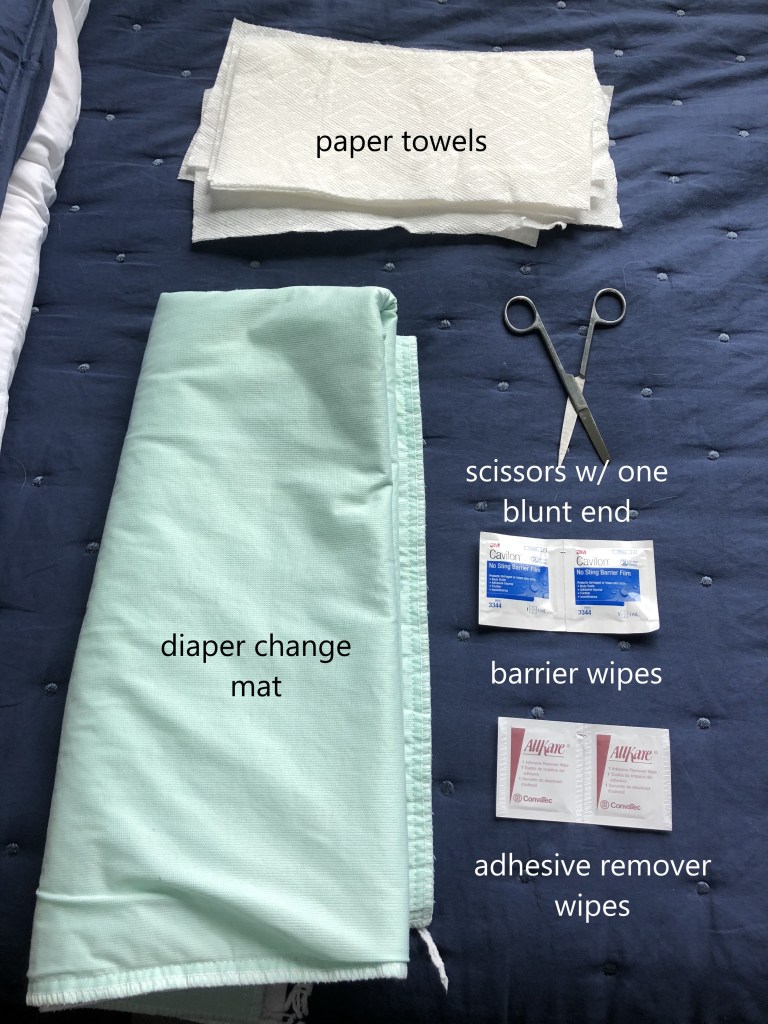
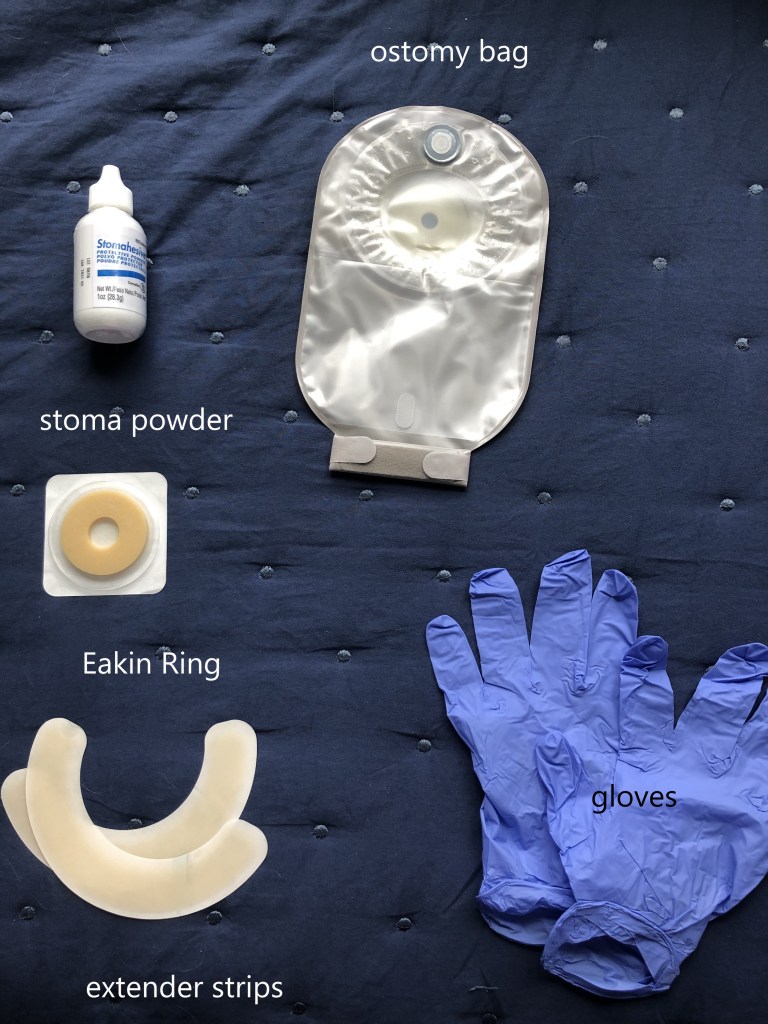
The first six to eight weeks after my ileostomy surgery were somewhat difficult. The difference this time was that I expected it. I was also used to changing the bag and leaks didn’t phase me. As it turns out, I had a leak just last night. Leaks now are annoying, but not the end of the world. I had expected to need a different type of bag than my colostomy bag, but as it turned out, the best bag system for my ileostomy was the same one I had used for my colostomy. When I had a colostomy, I only had to change my bag once a week. Now that I have an ileostomy, I have to change it every four days. This is largely a result of the consistency of the stool. Since it is more liquid, it is better able to get under the seal of the bag. Stool is very acidic on skin and keeping the skin around the stoma healthy is paramount. Broken skin is very painful and can keep the bag from sticking. Below I’ve included the things I use to change my bag.

In general terms, I first cut the hole in the new bag using a template from earlier changes. After putting on gloves, I use the adhesive remover wipes to remove the pouching system itself and any adhesive that is left behind. Without the remover wipes (or some other type of adhesive remover), you can easily damage the skin. Also, any adhesive left behind can keep you from getting a good seal and can lead to leaks. I make sure I use either a wet wash cloth or a wet paper towel to clean around my stoma. I don’t want any adhesive or adhesive remover left behind. I then change my gloves. I use two pairs of gloves so I don’t get stool on my skin under the new bag. I then use the stoma powder just around my stoma and then use the barrier wipes to get that powder wet. I do it again in a process called “crusting.” It both allows the skin underneath to heal and protect it from further breakdown. Next, I take out the Eakin ring and mold it to the shape of my stoma. It’s very sticky and easily moldable. Finally, I put on the new bag. On those days when I want extra confidence in my bag, I will use the extender stips around the bag. I don’t find them absolutely necessary, but they do give me the confidence that I have the new bag secure. I change my bag while laying on what amounts to a diaper change pad. I learned to change it lying down due to problems with my leg after my first surgery. I only have to wait 12-24 hours before getting it wet to allow the adhesive to fully adhere. I do it laying on the pad because the pad is easily washable if my ileostomy spurts while I’m changing it. I learned early on that eating a couple marshmallows about 30 minutes before the change can stop up my system long enough to change the bag. An ostomy has a mind of its own, but marshmallows for me help nudge it to my whims.These days, nearly 2 years after my colostomy, it only takes about 15 minutes to change it, and then I don’t have to worry about it for another four days. It’s now simply part of my routine.
Living With An Ileostomy, part 1

I wasn’t originally supposed to have an ostomy bag. When I had my first surgery, the initial plan had been to cut out the cancerous portion of my colon and reattach everything. However, I had a devil of a time with the bowel prep meant to clean out my colon prior to surgery. With that, my chances of waking up from surgery with a colostomy increased significantly. What no one knew until surgery began was that my tumor had grown in the three weeks since diagnosis and reattachment was no longer a wise idea. By that point, my tumor was blocking my colon in two different places and my surgeon was concerned about the possibility of what he called drop metastases. Drop metastases are little bits of cancer that break off from the main tumor and are too small to see. My surgeon wanted to wait until after chemotherapy to be sure any potential drop metastases had been killed before reattaching my colon.

A colostomy is where the surgeon takes part of the colon, or large intestine, and surgically brings it out through a hole in the abdomen. The portion of intestine brought to the surface is called a stoma. With a colostomy, stool is thick, or sometimes even formed. The colon itself is about 5 feet long, and the more colon the surgeon is able to leave intact, the thicker and more formed the stool will be. This is because one of the jobs of the colon is to remove liquid from the waste our intestines produce. An ileostomy is where the end of the small intestine, or the ileum, is surgically brought out through a hole in the abdomen. Stool that exits the body via an ileostomy is much more liquid than in a colostomy because there’s no colon to remove the excess water and return it back into the body. Dehydration is a much bigger problem with an ileostomy than a colostomy because instead of returning liquid to the body, it exits via the ileostomy.

The first weeks with an ostomy of any kind can be difficult. The stoma is constantly changing shape as it heals. The topography around the stoma is changing too as swelling goes down. There is also a lot of trial and error in finding the right pouching system and other products. An ostomy nurse is an excellent resource in finding the right products to try. Colostomy/ileostomy bags come as either one piece or two piece and as closed or drainable. You can do nearly everything with a colostomy or ileostomy that you did before. You can hike, shower, go swimming, and so many other things. There are some dietary changes most people make, as the small intestine isn’t quite up to the task of digesting some foods. The most common problem foods are seeds, nuts, and raw fruits and vegetables. Without those changes, intestinal blockages are much more likely.

Part 2 to come tomorrow

Survivorship

It is only in the last 15 years or so that the medical community has paid attention to “survivorship.” As cancer treatments get better, more and more people are living beyond cancer. As a result, more and more people are dealing with the long term physical, emotional, and mental effects of having had cancer. Cancer, especially late stage cancer, fundamentally changes who you are; you can’t go back to who you were before your diagnosis. Cancer doesn’t stop impacting your life just because you’ve finished treatment or your doctor says you have no evidence of disease. For me, cancer changed how I looked at the world. It especially changed how I saw God and His relationship to me. It changed my relationship with the Savior as well. I’m sorry to say that I’m not sure I’d have made those changes without my cancer diagnosis, but here we are. Cancer has also changed my relationships with the members of my family.

Fundamentally, survivorship is about what comes next after cancer. It’s about what long term side effects survivors can expect. The medical community is only starting to discover that many of the treatments used to fight cancer have significant long term side effects. Many of those side effects were unknown because cancer survivors weren’t living long enough for those side effects to present. Doctors are only recently educating survivors on some of those side effects, but it’s important that primary care doctors are educated too. Once a patient has been cancer free for x number of years, their care is transferred back to their primary care doctor, who may or may not be aware that cancer treatments can have long term side effects. By long term side effects, I am talking ten years, or even more, from the end of treatment. Despite the many advances in cancer treatment, much of it is still extremely destructive.

Cancer treatment also leaves its own mental and emotional scars. One such scar is something known as “chemo brain.” Chemo brain is categorized by cognitive difficulties both during after chemotherapy. I was lucky enough not to experience chemo brain. For some people, chemo brain can be debilitating.

Even after cancer treatment is over and one is considered cancer free, there can still be that feeling of “doom.” It’s difficult not to think that every new ache or pain is cancer returning. Suddenly, it’s difficult to differentiate between a normal sign of aging or benign problem and an early (or late) symptom of cancer. It can make you feel paranoid and like you’re overreacting. It’s a difficult balance to find, between being vigilant and overreacting. Myself, I’ve been out of active cancer treatment since March 1, 2019 and I still struggle at times to find that balance.

The last thing I want to mention is making the transition from active treatment to surveillance. Emotionally, it can be a difficult transition to make. It certainly has been for me. In illustration, take my course of treatment. From my official diagnosis on June 28, 2018 until I finished chemotherapy on February 24, 2019, I saw one of my doctors about every two weeks. During my recovery from surgery, I saw someone in my surgeon’s office twice. The first was for staple removal and the second was a check in. While I was actively on chemo, I saw my oncologist every two weeks. I would arrive at the clinic for blood work, after which I would see my doctor and he would confirm whether my blood counts were high enough for chemotherapy that day. It was like that like clock work. Then his office wanted to know if I got sick because that could delay chemo, or worse, land me in the hospital. From June 2018 – November 2019, I had ten separate hospitalizations. So during treatment, you’re under near constant supervision. Then one day, your doctor declares you cancer free and you move to surveillance mode. Suddenly you go from seeing your doctor every two weeks to seeing your doctor every 12 weeks. You had your oncologist and oncology nurses to help you navigate your new medical world, but there’s no one there to help you navigate your new post cancer world. It can leave you feeling adrift. It can be a scary thing, and it was for me. It’s something I still struggle with from time to time. But like so many other things in the cancer world, you learn to live with it. You remember how to put one foot in front of the other and just keep going. Cancer treatment isn’t for the faint of heart. Neither is surviving cancer.

Staying Positive Through Trial – Part 2

Staying positive through adversity is also about realizing that happiness is truly in our own hands. Happiness is a choice. Can we look for the silver lining through the clouds? Remaining positive through trial is a choice. It’s not about a lack of negativity, but rather about choosing to trust in the Lord and trusting that He has it all in hand. He’ll never leave us alone. He can’t. Sometimes it feels like we are alone, but I promise you that we’re not. All we have to do is look.

I cannot begin to tell you how many times at night I begged my Heavenly Father to make things just a little easier. From that first week in the hospital when I was diagnosed all through chemo, I cried out to my Heavenly Father to make things even just a little easier. Until I was diagnosed with cancer, I truly didn’t understand what it meant when the prophets cried out to Heavenly Father. I learned that Heavenly Father won’t always move our mountains, but he will always help us climb them if we reach out to Him and ask for His help.

My knowledge of the plan of salvation is something else that got me through. I grew up in The Church of Jesus Christ of Latter-Day Saints and went through both primary and young women’s.  I’ve been learning about the plan of salvation since before I can remember. But it wasn’t until cancer that it went from an abstraction to something that could truly work in my life. The plan of salvation helps us understand the reason we are here on earth  and that there is more to come when our time here on earth is done. It tells us that sickness and affliction are not permanent states of affairs. We learn that we have a Savior, Jesus Christ, who died not just for our sins, but for every pain and affliction and sickness we would face on earth. The plan of salvation gives us hope by telling us that pain and heartache and affliction are not permanent. They help us grow and their time will end. We learn we will be resurrected and our bodies will be without fault. My body will be free of cancer and genetic defect.  And even if things are not alright in this life, they will be in the life to come. In addition, when compared to eternity, this life is but a small moment.

In the end, staying positive through any trial comes down to this question. Do you trust your Heavenly Father to see you through?

Staying Positive Through Trial – Part 1

When I started my blog, I had a list of initial topics. However, I asked a few friends if there was anything they would like to see me talk about. One of them asked me to talk about staying positive through trials. The more I thought about it, the more it seemed the topic was perfect for my first real post.

When I tell people my story, more often than not, they are surprised at how positive I am, and how positive I stayed through my battle with cancer and treatment. In the beginning, it wasn’t a conscious decision. Over time, it certainly became that, but it didn’t start that way. I remember during my first hospital stay my parents remarking on how well I was dealing with the diagnosis. The only thing I knew for sure was that life kept going. Time didn’t stop just because I had cancer. In those initial days, all I could think was to just keep going. In fact, during those early days, I didn’t want to know the numbers and overall prognosis. I knew enough to know that stage iv cancer wasn’t good, but I didn’t want to know more than that. It took months before I was ready for that information. I learned several years ago that sometimes you just have to take things ten minutes at a time. You get through ten minutes, and then the next ten minutes and before you know it, an hour has passed. And then another an hour, and then a day and before you know it more time has passed than you thought possible.

There’s a quote I’ve always loved that I put into practice once I was diagnosed with cancer.

“Grant me the serenity to accept the things I cannot change, the courage to change the things I can, and the wisdom to know the difference.”

Reinhold Niebuhr

While I didn’t specifically think of that quote after I was diagnosed, I did think of my situation in terms of what I could change and what I could not. No matter what trial we are facing, we can divide it into two categories – what we can change and what we cannot. I couldn’t change that I had stage iv colon cancer. I couldn’t change that I didn’t find out I had Lynch Syndrome until I’d been diagnosed with late stage cancer. I couldn’t change that I had Lynch Syndrome. My mantra, if you like, became “it is what it is.” I couldn’t change what had already happened, but I realized I could change how I dealt with it. I could choose to be consumed by it, or I could learn to live with it. How we deal with our trials is up to us. We can choose to find help. We can choose our attitude. I promise you a positive attitude will make it easier for you and those around you. It’s not the be all answer, but it can’t hurt.

I had to learn the difference between what I could change and what I couldn’t change. I couldn’t afford to put my energy into what I couldn’t change; even before surgery and chemo, I didn’t have energy to spare. Banging my head against an immovable object wasn’t going to get me anywhere. Instead, I gave up the immovable object to God. I couldn’t do anything with it, but God could. Giving up our problems to God isn’t that easy though. It takes effort and a daily commitment. It’s not something we say we’re going to do one day, and then never make that decision again. It’s a daily decision we have to make.

Stay tuned for Part 2 tomorrow

Introduction

Welcome to my new blog, Faith & Cancer. My name is Jacqueline and I’ll be your host. The long version of my story can be found in the links about, but the short version is that shortly before I turned 33, I was diagnosed with stage IV colon cancer. A few weeks later, I was diagnosed with Lynch Syndrome as well. The combination of surgery and chemotherapy got me to NED status, or No Evidence of Disease. I’ve now been cancer free for nearly 2 years.

A cancer diagnosis is not an easy thing to live with. A stage IV cancer diagnosis is an even harder thing to live with. How do you continue to live your life even as you wrestle with your own mortality? Without question, my faith is what got me through. I belong to The Church of Jesus Christ of Latter-Day Saints. The world knows us as Mormons. I grew up in the church, learning about where we came from and where we’re going. I learned of my Savior, Jesus Christ and that He died for you and for me, and everyone else. I learned about so many things, but it wasn’t until I was diagnosed with cancer that all the things I learned became real to me.

I’ve started this blog to share my thoughts of my journey thus far and to share what comes next. I’m cancer free now, but I’m still at relatively high risk of it returning. Lynch Syndrome means I’m at higher risk of various cancers. My last surgery left me with Ovarian Remnant Syndrome. My health journey is far from over. My spiritual journey will never be over. Cancer forever intersected the two.